We Wrote a Constitution for the Humans We Build For
For most of this year, when someone asked me what AO1 is, the answer came out wrong. Not inaccurate. Just incomplete in a way that bothered me every time I said it.
I would describe the product. The technology. The architecture. Whichever lane the conversation was pointing toward, the answer always landed on what we built.
But the question deserved a different answer.
The technology is not the point. The technology is how. The humans are why.
A few months ago, I started writing down what we actually believe about the people we are building for. Not as a marketing exercise. Not as a positioning document. As a foundation we could return to when meetings got hard, when fundraising decks asked for sharper hooks, when we needed to remember why this work matters.
That document became the AO1 Constitution.
The gap that revealed itself.
The Constitution did not come from a strategic planning session. It came from noticing that we already had two foundational documents and they were both about the technology.
Trust Architecture is our framework for how we build responsibly. It governs privacy, memory, depth, and the boundaries the user controls. It is important. But it answers the question of how AO1 operates, not what we believe about the people who use it.
The Constitution sits underneath that. It answers a different question. What is the worldview that makes Trust Architecture necessary in the first place?
You cannot build emotional support for humans without first being clear about what you believe humans are.
What the Constitution is.
The Constitution opens with a preamble and contains twelve articles. Each article is short. None of them read like marketing copy. They read like quiet beliefs, the kind you carry without needing to announce.
I want to walk you through four of them. Not because they are more important than the others, but because they explain something specific about how AO1 was built and why it works the way it does.
Emotional presence does something real. It is not a soft add-on.
It is a real input into how someone experiences their day, their health, and their sense of being accompanied in the world.
Article II: Capability over deficiency.
The first article that shaped everything was Article II.
Most systems that touch human struggle start with what is wrong. Diagnosis. Symptom. Deficit. There is a question that gets asked everywhere, in clinical rooms, in HR conversations, in personal development books. What is wrong with this person.
We start somewhere else. We start with capability.
The question that organizes AO1 is not what is wrong with you. It is what would help you move through this.
The shift sounds small. In practice, it changes the entire experience of being supported. A person who walks into something built on capability does not have to perform their pain in order to be taken seriously. They do not have to translate themselves into a diagnostic category. They get to arrive as they are and ask for what would help.
That posture is built into the product because it is built into the belief.
Article V: Emotions are information.
The second article worth naming explicitly is Article V.
There is a cultural pattern, especially in high performing environments, that treats emotions as obstacles. Things to manage. Things to push past so you can get back to work.
We believe emotions are information.
They are signals. They carry data about what is happening, what matters, what needs attention. They are not problems to be solved or feelings to be pushed past. They are signs of a system that is paying attention.
The job of AO1 is not to fix the emotion. It is to help the person listen to what the emotion is telling them.
This is the philosophical lane AO1 occupies. It is why we do not use clinical language. It is why we describe what we do as emotional understanding and steadiness, never mental health. The distinction is not semantic. It reflects what we actually believe about what an emotion is.
Article XI: Voice matters.
The third article explains a product choice. Why voice.
People are shaped by voices. The voice you heard as a child. The voice that told you what you were capable of. The voice that told you what you were not. The voice you use to talk to yourself when no one else is listening.
We are formed by what reaches us through sound. A steady voice can settle a person in a way that text on a screen never will.
Voice is not the mission. Voice is one of the ways we reach you.
The voice is a layer, not the point. The belief underneath is that a person deserves something steady to listen to.
Article XII: Human development Is lifelong.
The last article I want to name is Article XII.
There is no final version of you. There is no graduation. There is no completed self.
A lot of the wellness and self improvement industry sells a destination. Arrive here. Become this. Finish the work. We do not believe in that destination because we have not seen evidence that it exists. The people we admire most are still becoming. The people who built lives we want to learn from kept going.
Human development is lifelong. AO1 is built to walk with people through that, for as long as they want company.
This is also why AO1 is not a crisis tool, not a one time intervention, not a phase. It is a presence available across the long arc of a life.

Why now.
Last week, Pope Leo XIV released an encyclical called Magnifica Humanitas. It is a long document, dense and careful, addressing what artificial intelligence means for human dignity. It was written for the Catholic Church but it pulled the broader cultural conversation into the open. What should AI be. What should it protect. What should it never replace.
I read it slowly. There is a great deal in it I agree with. The insistence that technology is never neutral. The reminder that efficiency is not the same as wisdom. The argument that human dignity is not earned or proven and cannot be reduced to what someone produces.
There is one framing in the encyclical I think about often. Leo XIV writes that artificial imitation of care can become risky when it enters contexts where real human relationships and emotional bonds are lacking. The concern is that people might gradually lose the desire to form genuine human connections.

I take that concern seriously and I want to add something to it.
For most of the people I have watched build deep connection, the people they want to be heard by are the people they already love. Family. Friends. Neighbors. The problem is rarely a lack of desire for human connection. The problem is availability. A mother who lives in a different time zone. A friend who is in the middle of their own hard week. A spouse who happens to be on a work call when the wave arrives.
There are quiet moments in every life when the person you want to talk to is not available. The question is what exists in that gap.
There is also something else worth saying. Sometimes a person is ruminating on a hard conversation, replaying it from only their side, unable to step back enough to see it from a wider angle. If they could offload that weight to something that has no stake in the outcome, just listens, reflects, maybe asks a different question, they might walk away with a softer heart. They might call the person they were avoiding. They might reach for the relationship instead of away from it.
In that case, the AI did not replace the human connection. It cleared the path back to it.
The encyclical also uses the word disarm in a way I want to honor. Leo XIV writes about disarming AI from the mentality of armed competition, freeing it from monopolistic control, opening it to human use. He also writes about disarming words. The link between the two is more than rhetorical. Both ask us to remove the weapon from how a thing approaches a person.
The Constitution lives in that same posture. It is the foundation underneath a product designed to approach a human being without weapons.
What closes the Constitution.
The Constitution ends with two lines.
That is the work. That is AO1.
Everything we build, every piece of architecture, every voice, every product decision, returns to those two lines.
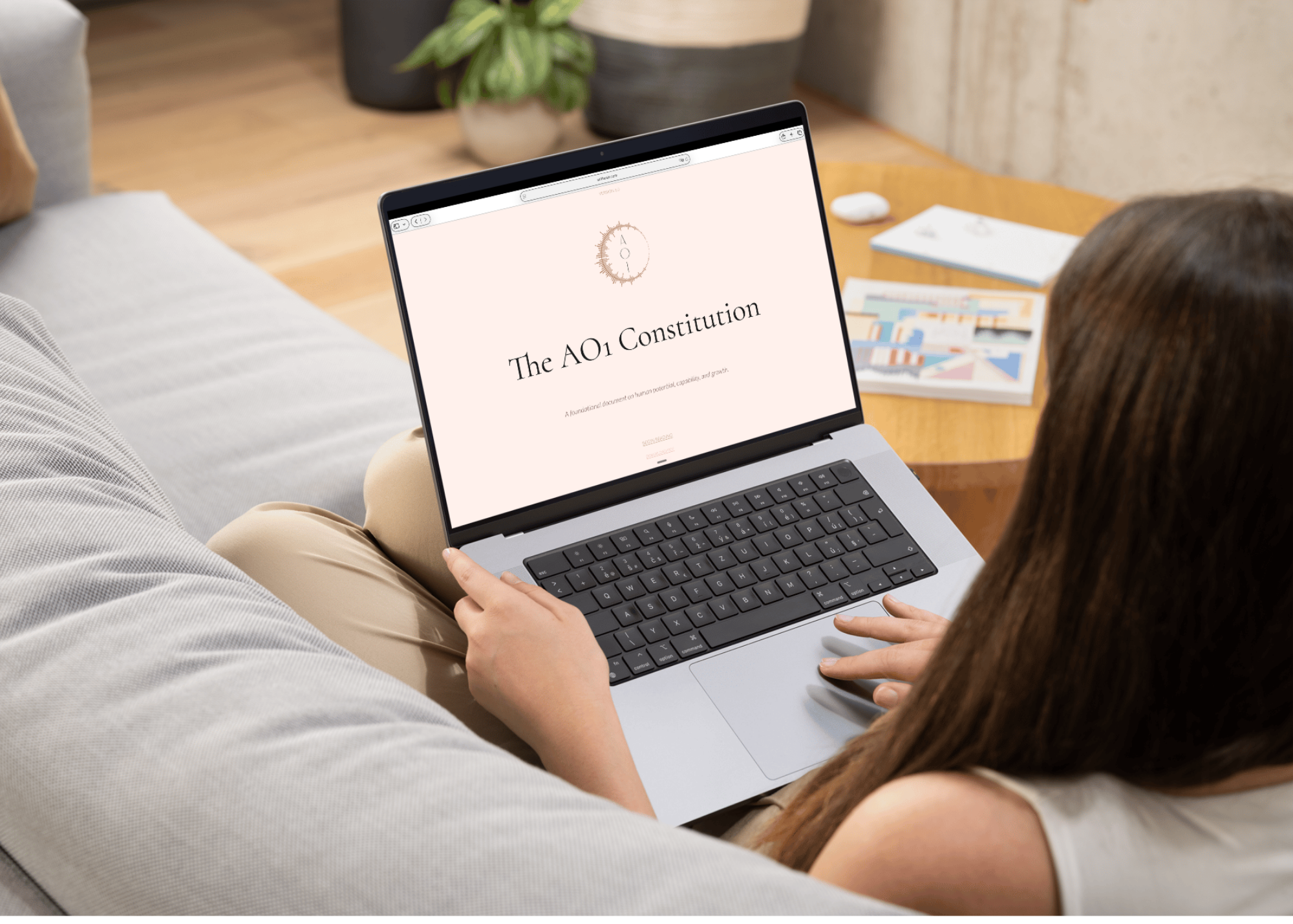
If you would like to read the full Constitution, including all twelve articles and the preamble, you can find it at The AO1 Constitution.
It is short. It is not a manifesto. It is the foundation we built everything else on top of.
