
Why Predictability Matters For Aging Nervous Systems

There is a man we see on the trail almost every day.
He rides his bike on the dirt path near our home, rain or shine, around the same time each morning. He has been doing it for at least four months, maybe longer. He wears the kind of shirts that announce him before he rounds the bend. Bright purple. Highlighter yellow. Greens so vivid they seem to hum against the brown and grey of the trail. He pedals uphill without assistance, on a path where plenty of younger riders quietly switch on their electric motors and pretend otherwise. He does not pretend otherwise.
In the beginning, he did not want to be greeted.
When Kynkai and I said good morning on our way up or called out a hello on our way back down, he responded the way someone responds when they are tolerating an interruption. A begrudging nod. A clipped acknowledgment that said, plainly, that we were a nuisance in the middle of his peace. He had the trail. He had his routine. He had not asked for company.
We greeted him anyway. Not to win him over. Not because we had a goal in mind. Not because we thought warmth would eventually crack something open in him. Simply because we were there, and so was he, and that is what you do when you share a stretch of road with someone every single morning.
Weeks passed. The trail stayed the same. We kept showing up. So did he.
And then one morning, something shifted.
He smiled first. A small one, but unmistakably real. A few days later he said something that made us laugh. Now, if we happen to be running a few minutes behind schedule, he notices. He will say something wry about our tardiness with the ease of someone who has earned the right to tease, something that tells us he has been paying attention all along, that somewhere along the way, without any single moment we could point to, we became a fixed point in the rhythm of his morning.
We did not earn that by saying the right thing. We did not earn it through effort or strategy or charm. We earned it by showing up the same way, at the same time, on the same path, until repetition turned us into something his body could recognize.
That is what predictability does. And it is one of the most underestimated forces in how we experience daily life as we age.
What The Nervous System Is Doing
The nervous system does not wait for something dramatic before it decides whether a situation is safe. It is not standing by, neutral and patient, until a crisis arrives. It is working constantly in the background of every moment, scanning the environment for signals that tell it whether to settle or brace.
It notices tone before it processes words. It notices pacing before it registers content. It reads familiarity, pattern, and repetition as signals of safety, and it reads disruption, unpredictability, and novelty as signals that require more energy to navigate. This happens quickly and below the level of conscious thought, which is why we often cannot explain why a space feels calm or why a particular voice makes us feel held. The body knows before the mind catches up.
Research in aging and emotion suggests that older adults often place greater value on emotionally meaningful and familiar experiences, and that emotionally charged or uncertain situations may require more effort to process later in life. This is not weakness. It is not cognitive decline. It is the nervous system doing precisely what it is designed to do: prioritizing what feels known, conserving energy, and protecting against unnecessary strain.
The nervous system does not measure safety in grand gestures. It measures it in repetition.
The implications of this for the environments where older adults spend their days are profound. And most care systems have not fully reckoned with them.
When Unpredictability Becomes A Burden
Consider what a typical day looks like inside an assisted living community. A resident wakes to a schedule that belongs, in many ways, to the institution rather than to them. Staff rotate across shifts. Faces change. The aide who helped with morning care may not be the same person who appears in the afternoon. The voice in the hallway sounds different. The rhythm of the day is structured around operational needs as much as emotional ones.
Each of those shifts requires something from the nervous system. A new face to assess. A new voice to read. A new interaction to navigate without the benefit of prior familiarity. Taken individually, none of these moments is significant. Taken together, across the course of a full day, they accumulate into a kind of low-grade cognitive and emotional labor that older adults are quietly absorbing while everyone around them attends to other things.
Research in dementia care and non-pharmacological intervention consistently shows that predictability, routine, and caregiver consistency can reduce agitation, confusion, and anxiety. Structured daily patterns, familiar caregivers, and calmer transitions are associated with better emotional steadiness and fewer behavioral disruptions. It is not the content of the routine that matters most. It is the fact that the routine exists, that it can be counted on, that the nervous system does not have to brace for what comes next.
And when the nervous system cannot find that predictability, it communicates the need in the ways it knows how. Repetition. Agitation. Withdrawal. The same story told three times in an afternoon, not out of defiance, but out of a body reaching for something familiar when nothing else in the environment feels like solid ground.

Agitation is often not misbehavior. It is a nervous system searching for something to hold onto.
That distinction matters enormously for how care communities respond. Because the instinct, when someone becomes agitated, is often to redirect, to add stimulation, to fill the space with activity. But what the nervous system is asking for is not more input. It is steadier input. Less novelty, not more. A familiar voice. A predictable tone. Something that has already been processed and filed under safe.
What Loneliness Actually Looks Like Here
Loneliness in senior living is rarely the absence of people. Most communities have staff, programming, activity calendars, and common spaces. Meals happen on schedule. There are classes and events and organized gatherings. From the outside, the day looks full.
But research on loneliness in congregate care settings shows that social isolation can still persist even when people are surrounded by others. The environment is structured, but the emotional experience inside it often depends on factors that shift constantly: who is on shift, who has time today, who happens to walk by at the right moment.
This is the gap most systems are not designing for.
Because loneliness at this stage of life is often not about the absence of people. It is about the absence of something the nervous system can count on. Something that shows up the same way each day without requiring the resident to perform, respond correctly, or be ready. Something that simply exists, steady and familiar, in the background of the hours when scheduled care has moved on and family has not yet arrived.
The nervous system does not measure loneliness by how many people are nearby. It measures it by how many of them can be counted on to return.
The man on the trail does not know us well. We do not share meals or histories or meaningful conversation. But his nervous system knows that we will be there. And that knowing is doing something real.
What Predictability Actually Produces
It is worth naming what predictability is not, because the word can be misread.
It is not monotony. It is not the elimination of variety, spontaneity, or joy from someone’s day. It is not a clinical protocol designed to flatten the texture of life inside a care community, or to remove from a resident the dignity of surprise and delight.
Predictability, in the context of nervous system regulation, means that certain things can be counted on. A familiar voice available at a consistent time. A tone that does not shift based on the caregiver’s mood or the busyness of the shift. A greeting that arrives with the same warmth it carried yesterday and will carry tomorrow, without requiring the resident to earn it by being in a good state or a cooperative frame of mind.
Research in dementia care supports this directly. Structured routines, consistent caregivers, and predictable transitions are associated with less agitation, less anxiety, and fewer behavioral disruptions. That does not mean every routine has to be rigid or every day identical. It means the nervous system benefits from being able to anticipate what comes next.
The mechanism is not complicated. When the nervous system knows what is coming, it does not have to brace. And when it does not have to brace, it can do something else entirely. It can open.
Predictability is not the absence of life. It is the foundation that makes fuller living possible.
That is what happened on the trail. The man in the bright shirts was not waiting for us to become interesting. He was waiting, without knowing he was waiting, for us to become reliable. And once we were, the rest followed naturally.

The Layer Most Communities Are Not Designing For
Senior living communities work extraordinarily hard to create safe, compassionate environments. The gap is rarely a lack of care or intention. It is the structural reality that even the most dedicated staff cannot provide the kind of consistent, predictable presence that the nervous system is looking for across every hour of every day.
Staff rotate across shifts. Schedules change based on operational need. Families visit when they can, which is often less frequently than any of them would choose. And in the long stretches between those human interactions, the nervous system is still scanning. Still looking for something familiar to settle into. Still asking, quietly and below the level of words, whether this particular moment is safe.
Most care systems are designed to answer the physical and medical dimensions of that question. They are designed for safety, which is essential, and for efficiency, which is necessary, and for clinical oversight, which saves lives. What they are not consistently designed for is the emotional steadiness that the nervous system requires in the hours when no scheduled interaction is happening and no one is immediately available to be present.
That is not a failure of care. It is a design gap. And it is one that the field is only beginning to name.
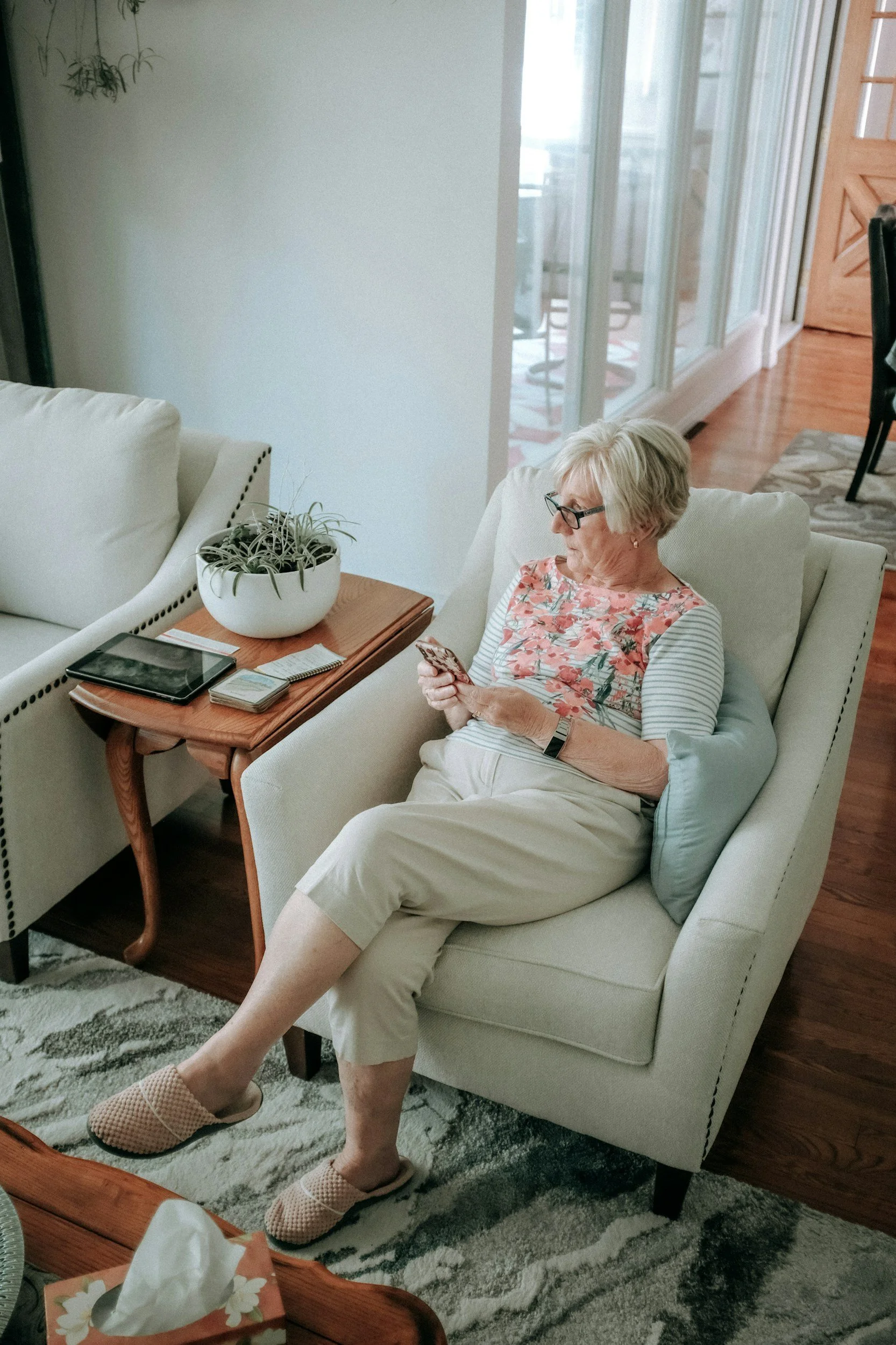
Emotional steadiness should be designed into care environments, not left to chance.
This is where the idea of emotional infrastructure becomes relevant. Not as a replacement for human connection, which is irreplaceable, but as a layer that exists in the space between human interactions. Something that shows up with the same tone, the same pacing, the same bounded and predictable presence, regardless of what else is happening in the building that day. Something the nervous system can begin to count on, the way it eventually counted on the two hikers who kept appearing on the trail every morning, rain or shine, at roughly the same time, with the same greeting, asking nothing in return.
What This Means for Guided Presence
Guided Presence was not built to manage agitation after it appears. It was built to exist in the space before agitation has reason to surface at all.
The AO1 Guided Presence Companion is an emotional wellness AI companion designed to meet you where you are with customized voice support and strict emotional guardrails. Unlike general-purpose AI, it does not retrieve information, solve problems, or respond to open-ended prompts without boundaries. It responds within a defined emotional space: steadiness, regulation, and the felt sense of not being alone. The voice adapts to the moment. The boundary holds. You stay in control throughout.
Scripted, predictable, user-controlled. It does not diagnose. It does not interpret. It does not attempt to assess what someone is feeling or track patterns over time. It offers something far simpler and, we believe, far more important: a calm, steady presence that a resident can return to during the quiet hours of the day when no one else is immediately available to listen. A place to speak and feel acknowledged, without being rushed, redirected, or required to perform wellness.
That matters because research in aging and dementia care consistently shows that tone, pacing, familiarity, and predictability shape emotional experience. A familiar rhythm, a gentle and unhurried voice, a predictable interaction that begins and ends the same way each time, these function as cues of safety. They tell the nervous system that this is a known quantity. That no bracing is required. That it is safe to settle.
What we are exploring at AO1 is not a replacement for human care. It is the infrastructure layer that can exist between those moments of human care, in the long unstructured stretches where distress often begins, quietly and without anyone immediately present to notice.
Presence over answers. A voice for the moment you’re in.
The man on the trail is not our friend in the traditional sense. We do not know his name. We have not been inside his home or heard the full story of his life. But his nervous system knows us. And that knowing, accumulated slowly over four months of the same trail and the same time and the same greeting, has produced something real. Something warm. Something that, on the mornings we run late, he notices enough to mention.
That is what consistent presence builds. Not performance. Not gratitude. Just the quiet, steady opening of a nervous system that has finally decided it does not have to brace for what comes next.
That is what we are building Guided Presence to offer. One small layer of that steadiness. In the quiet hours. When no one else is available to be the fixed point on the trail.
Emotional infrastructure is not a luxury layer. It is the layer that makes everything else in a care environment possible.
If you work within a senior living community and are curious about what emotional infrastructure could look like inside your environment, we would welcome a conversation about what that might mean for your residents.
You can experience the current version of Guided Presence on the Experience AO1 page.
Begin the Conversation at ao1heals.com
Not therapy. Not a replacement for human care. A steady presence in the quiet hours.
